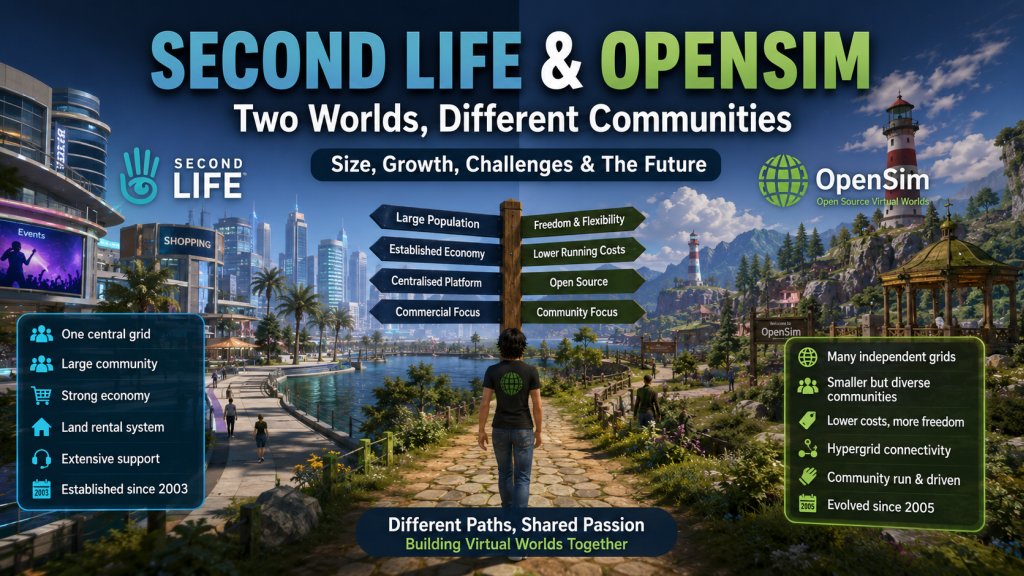
For more than two decades, Second Life and OpenSim have existed side by side, sharing many similarities while evolving into very different communities. Both allow people to create virtual worlds, build homes and businesses, socialise with friends and explore thousands of unique destinations. Yet despite looking similar on the surface, they have developed very different cultures, economies and long-term challenges.
Second Life remains the largest and most commercially successful virtual world. Operated by Linden Lab, it provides a single, centrally managed grid with its own economy, Marketplace, land rental system and extensive support infrastructure. Everything exists within one connected world, making it easy for residents to discover new places, attend events and buy content from thousands of creators. The strength of Second Life has always been its critical mass. A large population encourages businesses to invest in creating products, musicians and performers to organise live events, and communities to flourish around almost every imaginable interest.
OpenSim takes a very different approach. Rather than one central world, it is made up of hundreds of independent grids, each managed by different owners with their own rules, communities and technical infrastructure. Some grids are commercial, while many are run entirely by volunteers. Hypergrid technology allows users to travel between participating grids, creating what is effectively a decentralised metaverse. This gives OpenSim enormous freedom and flexibility, with region hosting costing only a fraction of the equivalent land in Second Life. For educators, hobbyists, role-playing communities and anyone wanting complete control over their own virtual environment, OpenSim offers opportunities that simply do not exist elsewhere.
The size of the two communities reflects these different approaches. Second Life continues to attract a significantly larger daily population, supported by an active economy and regular development from Linden Lab. OpenSim’s user base is much smaller, but it remains surprisingly resilient. Across the public grids, active users have recently approached 50,000, the highest reported level since Hypergrid Business began tracking public OpenSim statistics in 2009, although these figures represent activity across many separate grids rather than a single virtual world.
One question frequently asked by both communities is whether younger users are joining. Unfortunately, there are no reliable public demographic figures for either platform. However, many long-term residents believe that the average age of users has gradually increased over the years. Many people who joined during the boom years of virtual worlds have simply stayed, growing older alongside the platforms themselves. At the same time, attracting younger generations has become increasingly difficult. Today’s internet users have grown up with social media, mobile gaming, streaming platforms and modern multiplayer games offering instant access and visually impressive experiences. Learning to use a virtual world such as Second Life or OpenSim requires considerably more patience.
That does not mean younger people are absent. New users continue to join both platforms every year, particularly those interested in content creation, role-play, education and virtual communities. However, they are not arriving in the numbers seen during the mid to late 2000s. Retaining newcomers is arguably a greater challenge than attracting them. Both platforms have steep learning curves, unfamiliar interfaces and complex inventories that can overwhelm first-time visitors.
The financial models also differ significantly. Second Life benefits from a well-established economy based on land ownership, Premium memberships and the Linden Dollar. Professional content creators can build successful businesses, and consumers generally know where to shop for high-quality products. OpenSim, by comparison, has a much smaller commercial market. Many grids provide free land, free content and generous starter packages, making it attractive for hobbyists but more difficult for professional merchants seeking regular income. As a result, OpenSim relies heavily on volunteers, donations and the enthusiasm of grid owners who invest their own time and money into maintaining their communities.
Recent events surrounding OSgrid have highlighted one of OpenSim’s greatest strengths as well as one of its biggest weaknesses. Earlier this year, OSgrid experienced an extended outage while major maintenance was carried out on its asset storage systems. Because OSgrid is one of the largest and oldest OpenSim grids, the interruption affected thousands of residents and temporarily reduced activity across the wider OpenSim ecosystem.
However, the decentralised nature of OpenSim also demonstrated its resilience. Other grids continued operating normally, users temporarily visited alternative destinations, and once OSgrid returned, activity recovered quickly. In fact, the latest public statistics showed active user numbers reaching record levels after the grid came back online.
Second Life faces different challenges. Because everything is hosted on one central platform, residents generally benefit from greater stability, professional support and consistent development. Planned maintenance is routine, and while technical problems do occasionally occur, Linden Lab continues to actively maintain and improve the platform.
Perhaps the greatest challenge facing both communities is not technology but visibility. Virtual worlds no longer dominate technology headlines as they once did. Competition now comes from social VR platforms, sandbox games, multiplayer survival games, AI-driven experiences and immersive online communities that did not exist when Second Life first launched. Both Second Life and OpenSim must continually demonstrate why persistent virtual worlds remain relevant in an increasingly crowded digital landscape.
Despite these challenges, both communities continue to offer something genuinely unique. They are not simply games but places where people create, collaborate, learn, perform, teach, build businesses and form friendships that often last for many years. For many residents, these virtual worlds have become an important part of their lives.
Looking ahead, the future of both platforms will depend on their ability to welcome new generations without losing the communities that have sustained them for so long. Easier onboarding, modern user interfaces, better discovery tools and continued investment in creators will all play an important role. Whether through the commercial strength of Second Life or the openness and creativity of OpenSim, virtual worlds continue to evolve, proving that even after more than twenty years they still have an important place on the internet.











Leave a Reply