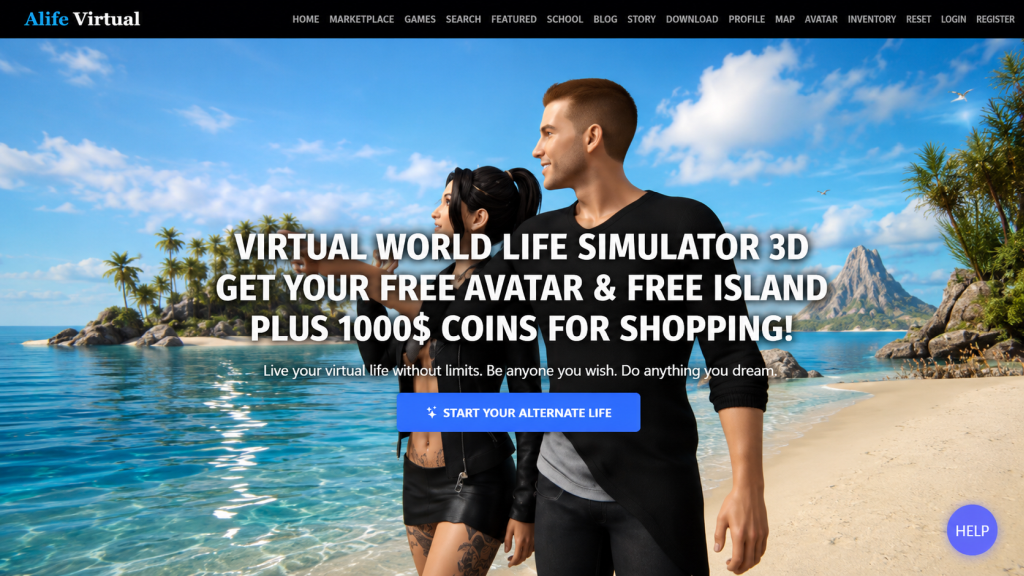
Among the many OpenSim grids available today, ALife Virtual has chosen a noticeably different path. Rather than embracing the Hypergrid and becoming part of the wider interconnected OpenSim universe, ALife operates as a completely closed grid. Its philosophy is centred on creating a self-contained virtual world where residents can build, socialise and learn without relying on external grids or services.
The project is led by Sorin Todys, who is not only the owner of ALife Virtual but also its principal designer, educator and driving force. Throughout the grid, he has played a central role in developing its destinations, educational programmes and overall vision, with a strong emphasis on helping newcomers discover and enjoy OpenSim.
The ethos behind ALife Virtual is simple: remove the financial barriers that often prevent people from creating their own virtual worlds. The grid promotes itself as a platform built by creators for creators, where the emphasis is placed on learning, experimentation and ownership rather than expensive monthly land fees. Much of its promotional material contrasts the cost of owning land in Second Life with the opportunity to obtain a private region free of charge within ALife.
One of ALife’s most attractive features for newcomers is its free private island programme. New residents are offered their own 256 x 256 metre region, providing approximately 65,536 square metres of virtual land to develop as they wish. The region is allocated through an automated land claim system, allowing users to become virtual landowners within minutes of registering. Unlike many grids that require applications or approval by administrators, ALife has streamlined the process so that new users can quickly begin building their own environments.
The grid also places considerable emphasis on education. The ALife Virtual School offers structured courses aimed at helping newcomers understand every aspect of OpenSim, from basic movement and communication through to building, scripting and advanced content creation. The school is organised into several learning academies, with many of the courses presented or overseen by Sorin Todys himself, reflecting the project’s strong commitment to teaching as well as technology.
Unlike the majority of OpenSim grids, ALife deliberately does not support Hypergrid travel. This means residents cannot teleport directly to or from other OpenSim grids using Hypergrid addresses. According to the grid’s published philosophy, this is a conscious decision intended to provide greater stability, improve security and create a more consistent user experience within a carefully managed environment. Rather than encouraging movement between grids, ALife aims to build its own independent virtual community.
Getting started is straightforward. After creating an account, users simply download the OpenSim version of the Firestorm Viewer and add the ALife grid manually using its Login URI.
Once the Login URI has been added to Firestorm, residents enter their account details and are transported to the Welcome Centre, where tutorials, orientation areas and teleport links help them begin exploring the grid.
Beyond free land, ALife promotes several additional benefits including unlimited uploads, modern mesh avatars supplied to new users, an integrated virtual economy, creator tools and optional premium upgrades for those wishing to expand beyond the free region allocation. The grid also offers active community support, detailed documentation and an extensive help system designed to assist both beginners and experienced virtual world builders.
One aspect that distinguishes ALife from many other OpenSim projects is the amount of effort invested in presentation. The website is professionally designed, featuring extensive tutorials, destination guides, educational resources and promotional material that seeks to make the platform approachable for users who may have little or no previous experience of OpenSim. This emphasis on accessibility reflects the grid’s ambition to appeal not only to experienced OpenSim residents but also to those looking for an alternative to Second Life.
Although ALife chooses to remain separate from the wider Hypergrid community, it nevertheless demonstrates how flexible OpenSim can be. Some grids embrace openness and interconnectivity, while others, such as ALife, prioritise a carefully curated experience within a self-contained virtual world. Neither approach is inherently right or wrong; they simply reflect different philosophies about how virtual communities should evolve.
For anyone seeking an OpenSim environment that combines free private land, structured learning, creator-focused tools and a carefully managed community, ALife Virtual offers an interesting alternative. Under the guidance of Sorin Todys, the grid continues to position itself as a platform where creativity, education and accessibility are placed at the heart of the virtual world experience.