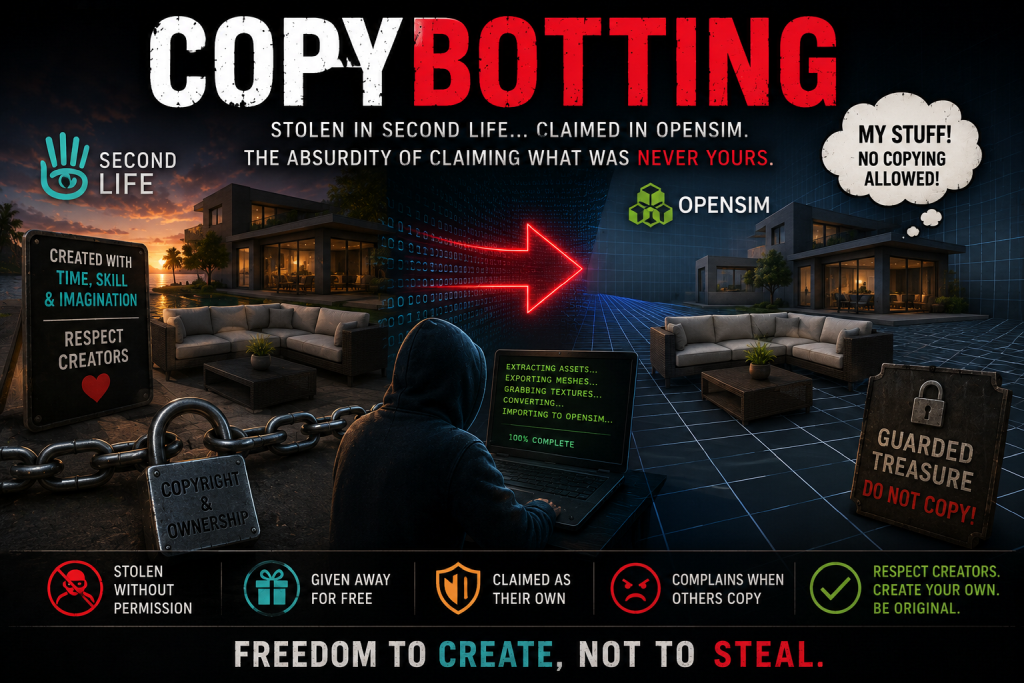
Few topics generate as much debate in the virtual world community as copybotting. For more than a decade, creators have watched their work appear on other platforms without permission, often stripped of its original ownership and redistributed as though it had been created by someone else. Although content theft exists in many online environments, the relationship between Second Life and OpenSim has made the issue particularly visible.
Copybotting is the name commonly given to the process of copying digital assets from one virtual world without the permission of the original creator. In the early days of Second Life this involved specialised software that intercepted the information being sent from the server to the viewer. Since a viewer must receive information about objects, meshes and textures in order to display them on screen, determined individuals discovered ways to capture that data and reconstruct it elsewhere.
Modern copybotting has become considerably more sophisticated. Rather than simply copying prim objects, tools have been developed that can extract mesh models, textures, animations and even complete regions. These assets can then be converted into formats suitable for OpenSim and imported into a privately hosted region or grid. Although the process often requires technical knowledge and additional software, it has unfortunately become much easier than it once was.
It is important to distinguish between OpenSim and the people who misuse it. OpenSim itself is simply an open-source virtual world platform. It does not contain stolen content, nor does it encourage copyright infringement. The overwhelming majority of OpenSim users build their own regions, purchase legitimate content, use freely licensed assets or create original work. Many talented builders and artists have produced remarkable virtual environments entirely from their own imagination.
Unfortunately, the openness of OpenSim has also attracted individuals who see it as a convenient place to store or distribute content taken from Second Life without permission. Because anyone can host their own grid, there is no central authority overseeing every region in the same way that exists within Second Life. This makes enforcement of copyright more difficult, particularly on small private grids that may have only a handful of users.
Perhaps the most curious aspect of this behaviour is the contradiction that sometimes follows. It is not uncommon to encounter OpenSim regions filled with buildings, furniture, vehicles and avatars that have clearly originated in Second Life. The owners of these collections may openly share them with friends or offer them as free gifts to visitors, despite having no legal right to distribute them in the first place.
Yet the irony often becomes apparent when someone copies those same items again. Individuals who were perfectly happy to import content created by someone else can become extremely protective of their own collection of stolen assets. Complaints suddenly arise that another grid has copied “their” inventory, “their” region or “their” exclusive content, even though the material originally belonged to entirely different creators in Second Life.
This creates one of the strangest paradoxes in OpenSim. An object may have been stolen from its legitimate creator, imported into OpenSim without permission, freely distributed across several grids and then fiercely defended by the person who copied it. The original act of copying is overlooked, while later copies are condemned. From an outside perspective, it is difficult not to see the absurdity of claiming ownership over something that was never yours to begin with.
Of course, this behaviour does not represent the OpenSim community as a whole. Many grids actively discourage copyright infringement and encourage residents to create original content or use material released under appropriate licences. A growing number of creators now build specifically for OpenSim, producing original mesh, textures, scripts and animations that are legitimately shared or sold within the community.
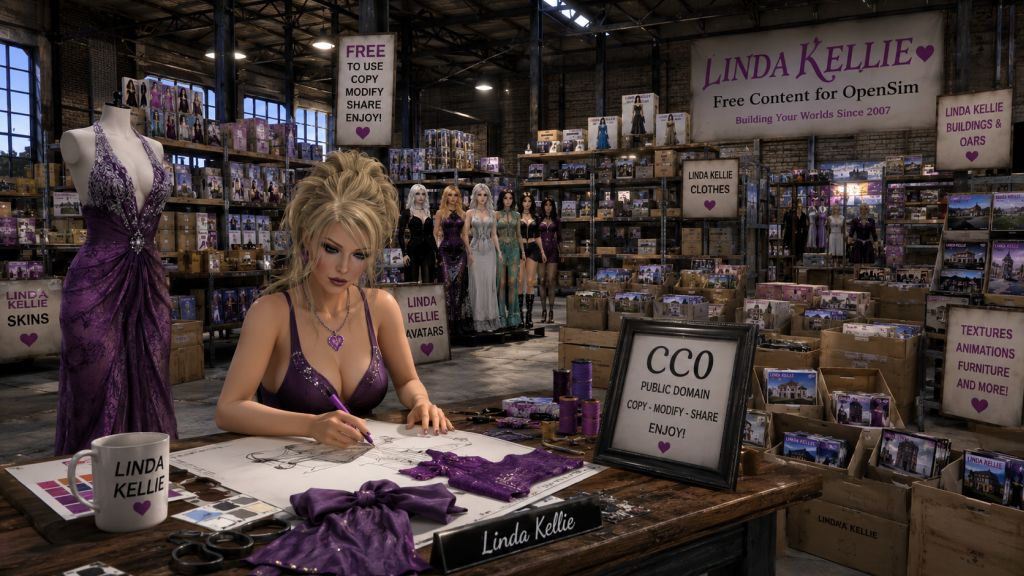
The increasing availability of AI-assisted modelling tools, Blender, public-domain assets and Creative Commons resources has also made it easier than ever for creators to produce original content without relying on stolen material. As these tools continue to improve, there is less justification for importing copyrighted assets from elsewhere.
Ultimately, copybotting harms everyone involved. It discourages talented creators from sharing their work, damages trust between virtual world communities and undermines the reputation of OpenSim, despite the fact that the software itself is entirely neutral. The future of OpenSim depends not on copying what already exists, but on encouraging creativity, originality and respect for the intellectual property of others.
Perhaps the greatest irony of all is that OpenSim was created to provide freedom. The freedom to build, to customise, to experiment and to create entire virtual worlds without commercial restrictions. That freedom is at its strongest when residents use it to produce something uniquely their own, rather than claiming ownership of creations that rightly belong to someone else.










Leave a Reply